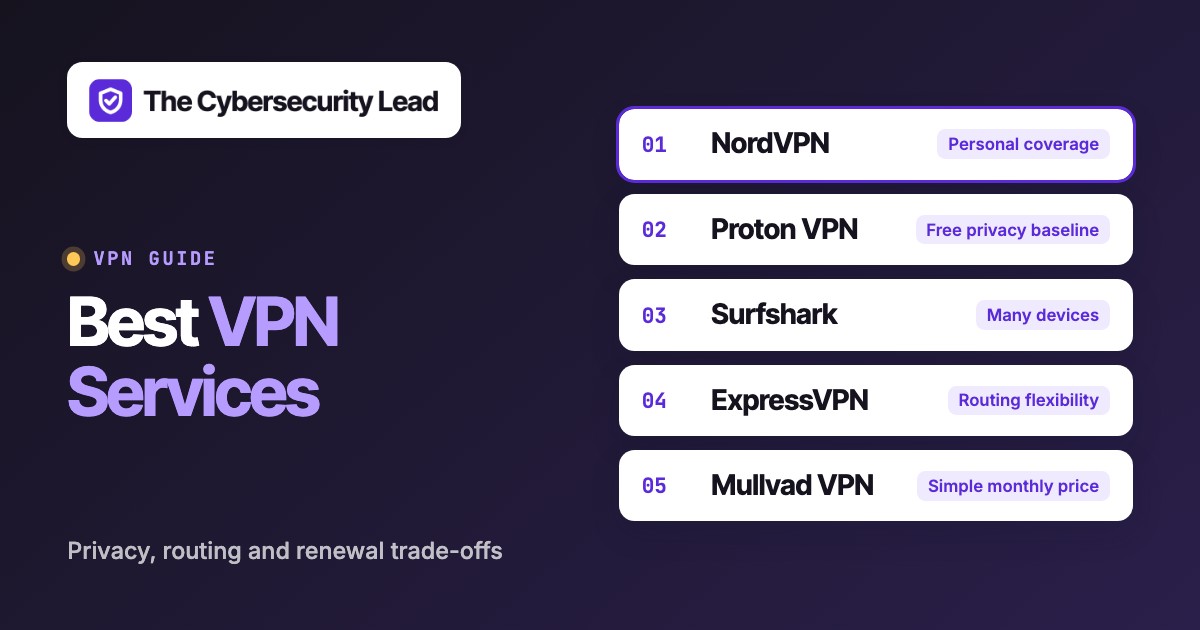
The best VPN services protect a network connection, but they don't replace endpoint security, multifactor authentication or company-managed access. A security lead should choose based on the traffic at risk, device compatibility, tunnel failure behavior and the subscription's renewal terms.
For everyday personal coverage,  NordVPN is a useful starting comparison.
 Proton VPN offers a free tier without a data cap,
 Surfshark supports many personal devices,
 ExpressVPN has detailed split-tunneling documentation and
 Mullvad VPN uses a flat euro-denominated price. These are editorial use-case selections, not results of a laboratory speed test.
Best VPN services by use case
The best VPN depends on whether you need basic personal privacy, numerous connected devices or explicit traffic-routing controls. None of these consumer subscriptions is a substitute for centrally administered business access, and they aren't meant to be.
- Personal coverageNordVPNConsumer VPN with device-wide protection and configurable connection controls.
- Free privacy baselineProton VPNPrivacy-focused VPN with a documented free tier and Secure Core on paid plans.
- Many devicesSurfsharkConsumer VPN with unlimited simultaneous connections and Bypasser routing.
- Routing flexibilityExpressVPNConsumer VPN with app and website routing options on supported platforms.
- Simple monthly priceMullvad VPNPrivacy-oriented VPN with account-number access and straightforward billing.
VPN services compared
A VPN comparison shouldn't mix documented capabilities with claims about speed and anonymity. Device allowances, routing exceptions and billing terms can be checked; an unsourced ranking can't.
| Tool | Use case | Operational role | Pricing reference | What it is |
|---|---|---|---|---|
| NordVPN | Consumer VPN | Personal-device VPN, not enterprise access control | From EUR 3.49/mo on the 2-year Basic plan (EUR 94.23 for the first 27 months), renews at EUR 139.08/year | Consumer VPN with device-wide protection and configurable connection controls. |
| Proton VPN | Privacy VPN | Free privacy baseline and paid Secure Core routing | Free tier; Plus from $3.49/mo on 24 months ($83.76 upfront), renews at $83.88/year | Privacy-focused VPN with a documented free tier and Secure Core on paid plans. |
| Surfshark | Consumer VPN | Numerous personal devices under one subscription | From EUR 2.49/mo on the 24-month plan (EUR 67.23 for the first 27 months), renewal price not stated on the plan page | Consumer VPN with unlimited simultaneous connections and Bypasser routing. |
| ExpressVPN | Consumer VPN | Platform-specific split tunneling and Lightway connection | From EUR 2.49/mo on the 28-month Basic plan (EUR 69.72 first term), renews at EUR 79.95/year | Consumer VPN with app and website routing options on supported platforms. |
| Mullvad VPN | Privacy VPN | Account-number access and flat euro price | EUR 5 per month, same price for any term | Privacy-oriented VPN with account-number access and straightforward billing. |
Figures are what each vendor's storefront showed a European visitor on October 25, 2026 (Proton VPN in USD). The 27- and 28-month terms are the 24-month plan plus bonus months. Promotions, US checkout currency and tax can vary.
Where a VPN belongs in a small security program
A consumer VPN encrypts traffic between a device and a VPN provider, but it doesn't decide which company applications an employee may use. Identity, device protection and DNS security still need their own controls.
- 1Secure devicesBreaks when Patch systems and browsers; apply appropriate endpoint controls.
- 2Protect the network path
- NordVPN
- Proton VPN
- Surfshark
Breaks when Test reconnect, kill switch and DNS behavior. - 3Authorize work accessBreaks when Use corporate MFA and managed identity rather than a shared consumer account.
- 4Verify domain recordsBreaks when Check SPF, DMARC, MX, NS and CAA separately from VPN configuration.
A genuinely useful VPN pilot includes a forced connection drop and an application that must use the local network. Record which traffic still flows and which control blocks it. The connect indicator alone clearly doesn't prove the policy is correct.
NordVPN: a personal-device VPN, not enterprise access control
NordVPN is the most familiar everyday pick here, and its support documentation spells out how its kill switch interacts with split tunneling. Consumer VPN with device-wide protection and configurable connection controls. Check that against the devices and traffic you actually need to protect.
NordVPN
Consumer VPN with device-wide protection and configurable connection controls.
Consumer VPN with device-wide protection and configurable connection controls.
- personal VPN coverage across mixed devices
- documented kill switch and routing behavior
- employee identity and access governance
- teams requiring centrally administered access
How it works in practice
NordVPN's support documentation describes a subtle interaction: Internet Kill Switch can block traffic that split tunneling otherwise excludes. That means an app that must reach a local service can fail when a security setting is enabled. Test this on the exact operating system rather than disabling the control blindly. The provider also documents ten simultaneous device connections, but that doesn't turn a consumer account into ten separately managed employee identities. For a small company, treat this as a personal network privacy tool and keep corporate SSO, device compliance and access logs separate.
- Starting price
- From EUR 3.49/mo on the 2-year Basic plan (EUR 94.23 for the first 27 months), renews at EUR 139.08/year
- Devices
- 10
- Routing
- Kill switch and split tunneling
For a small security team, document the purchase owner and the cancellation path. A consumer VPN can't replace business identity, device governance or an audit trail merely because it offers additional security features.
Proton VPN: free privacy baseline and paid Secure Core routing
Proton VPN is the only one of the five that's got a free tier you can test before you pay anything. Privacy-focused VPN with a documented free tier and Secure Core on paid plans. What matters is whether that fits your devices and the traffic you need to cover.
Proton VPN
Privacy-focused VPN with a documented free tier and Secure Core on paid plans.
Privacy-focused VPN with a documented free tier and Secure Core on paid plans.
- an unlimited-data free tier for a baseline evaluation
- published explanations of VPN privacy architecture
- free tier must provide every exit location
- business-wide central identity administration
How it works in practice
Proton's support material says the free tier has unlimited data and permits one simultaneous device. So the limit isn't a data meter, it's a feature and device restriction. A pilot should test the connection on a travel network, the effect of a forced disconnect and the availability of an exit location that meets the user's needs. Paid Secure Core adds a hardened entry-server hop before the exit server. It changes the network path, and it doesn't make the device itself any more trustworthy, so don't treat it as a fix. Use Proton's documented configuration steps to verify the path, and don't assume a premium badge guarantees protection.
- Starting price
- Free tier; Plus from $3.49/mo on 24 months ($83.76 upfront), renews at $83.88/year
- Free data
- Unlimited
- Free devices
- 1
- Paid feature
- Secure Core
Whoever buys the plan should also own renewals, so you'll want to record the purchase owner and the cancellation path before rollout.
Surfshark: numerous personal devices under one subscription
Surfshark suits a household that's got more devices than most plans allow, as long as you've read the renewal terms. Consumer VPN with unlimited simultaneous connections and Bypasser routing. It's a clear fit only if the device mix and the traffic at risk match.
Surfshark
Consumer VPN with unlimited simultaneous connections and Bypasser routing.
Consumer VPN with unlimited simultaneous connections and Bypasser routing.
- many personal devices share one household subscription
- you need documented split-tunnel exceptions
- centralized employee account offboarding
- you expect a discounted first-term rate to last forever
How it works in practice
Surfshark's official pricing page says it offers unlimited simultaneous connections and Bypasser split tunneling. The device allowance is handy if you've got a laptop, phone and several home devices, but it isn't a corporate seat-management product. Test each supported operating system and record which apps bypass the encrypted tunnel. The provider's pricing page can present a long prepaid period as a small per-month equivalent, and the checkout can differ by currency and tax. Keep the total charge and the renewal disclosure together, and don't compare sale banners.
- Starting price
- From EUR 2.49/mo on the 24-month plan (EUR 67.23 for the first 27 months), renewal price not stated on the plan page
- Devices
- Unlimited
- Routing
- Bypasser
A prepaid long-term plan locks in money before you know whether the app suits your devices, so use the 30-day money-back guarantee to run the pilot first.
ExpressVPN: platform-specific split tunneling and Lightway connection
ExpressVPN stands out for how it documents split tunneling, which is what you'll need when a printer or local app must stay off the tunnel. Consumer VPN with app and website routing options on supported platforms. Judge it by the devices and traffic it must cover for you, not by its marketing copy.
ExpressVPN
Consumer VPN with app and website routing options on supported platforms.
Consumer VPN with app and website routing options on supported platforms.
- a printer or local app requires an explicit routing exception
- platform-specific routing documentation matters
- the organization needs access approvals or SSO
- exceptions can't be reviewed by the security owner
How it works in practice
ExpressVPN's feature documentation describes split tunneling for selected apps and websites, with capabilities that vary by platform. A practical test protects the browser while letting a specific local device talk directly. An excluded application no longer uses the VPN tunnel, so a security owner should document the reason for each exception. ExpressVPN also describes its Lightway protocol and publishes technical detail, but that documentation alone isn't proof that a particular user will see the fastest connection. Always test reconnect behavior and DNS routing in the environment that matters.
- Starting price
- From EUR 2.49/mo on the 28-month Basic plan (EUR 69.72 first term), renews at EUR 79.95/year
- Routing
- Split tunneling varies by platform
- Protocol
- Lightway
Every routing exception widens what the tunnel doesn't cover, so keep a written list and review it when the plan renews.
Mullvad VPN: account-number access and flat euro price
Mullvad's the simplest to budget for, because the price is the same whatever term you pick. Privacy-oriented VPN with account-number access and straightforward billing. It earns a place only when it covers the traffic you actually care about.
Mullvad VPN
Privacy-oriented VPN with account-number access and straightforward billing.
Privacy-oriented VPN with account-number access and straightforward billing.
- predictable euro-denominated monthly pricing
- minimizing personal account data is a priority
- you require a published USD list price
- corporate identity controls are necessary
How it works in practice
Mullvad publishes a flat five-euro monthly rate and its terms permit an account on up to five devices. Account-number access cuts down the identifying information you have to hand over, though no VPN guarantees anonymity. Mullvad itself warns that a VPN alone isn't enough for privacy and suggests using a privacy-focused browser. For a US buyer, the currency is a material difference from a dollar-denominated checkout. Mullvad bills in euros and its pricing page shows dollar figures only as approximate equivalents. This service remains a personal privacy control, not an employee access management platform.
- Starting price
- EUR 5 per month, same price for any term
- Price
- EUR 5/month
- Devices
- Up to 5
How to evaluate a VPN without overbuying
VPN evaluation starts with a threat model and a device inventory, not a promotional price. Test routing behavior, note exceptions and compare what you're actually billed first with what you'll owe at renewal.
- Define the network threat and what a VPN can mitigate.
- List supported operating systems and device counts.
- Force a tunnel disconnect and observe the kill switch.
- Record split-tunnel exceptions and their business justification.
- Capture upfront charge, renewal cadence and cancellation instructions.
- Separate corporate identity controls from personal VPN coverage.
- Check domain and email DNS records as a different security control.
What a VPN doesn't protect
A VPN definitely doesn't make a compromised device safe, stop credential phishing or verify a company domain's email authentication. It moves the network trust boundary toward the VPN provider, so provider trust and device security still matter.
When to use Domain Drift
Domain monitoring and VPN protection answer different questions. Our own product, Domain Drift, is a read-only monitor: it checks the public SPF, DMARC, MX, NS and CAA records of up to 10 domains once a day and shows each confirmed change as a diff. A consumer VPN protects a device's network path instead, so the two don't compete.
Frequently asked questions about VPN services
VPN questions usually concern privacy limits, business suitability and whether a free plan is sufficient. A VPN can help with network privacy, though it can't guarantee anonymity or substitute for centrally managed company security.
What is the best VPN for a small business?
The best VPN for a small business depends on whether it's after personal privacy or centrally managed employee access. A consumer VPN isn't a replacement for corporate identity and device controls.
Does a VPN stop phishing?
A VPN doesn't stop phishing by itself, and that's the point most buyers miss. Some bundles offer malicious-site filtering, but you'll still need phishing-resistant authentication and device safeguards.
Is a free VPN enough for occasional travel?
A free VPN can be enough for basic personal use when you're comfortable with its limits. Proton VPN publishes a free tier without a data cap, but its feature and device allowances differ from paid plans.
Why do apps stop working when I connect to a VPN?
A VPN can change routing, DNS behavior and the visible exit IP, which is why some apps don't behave. Test the app and document any split-tunnel exception rather than turning off protection without a reason.
Can a VPN replace corporate remote access?
A consumer VPN can't replace the user provisioning, MFA policy and audit controls expected from a managed business access system.